Only 4 States Get an A: What the Phone-Free Schools Report Card Reveals
A coalition of advocacy groups grades every U.S. state's phone law against a model bill. Only four earn the top A grade. Here's what separates them.
A new report card for state phone laws
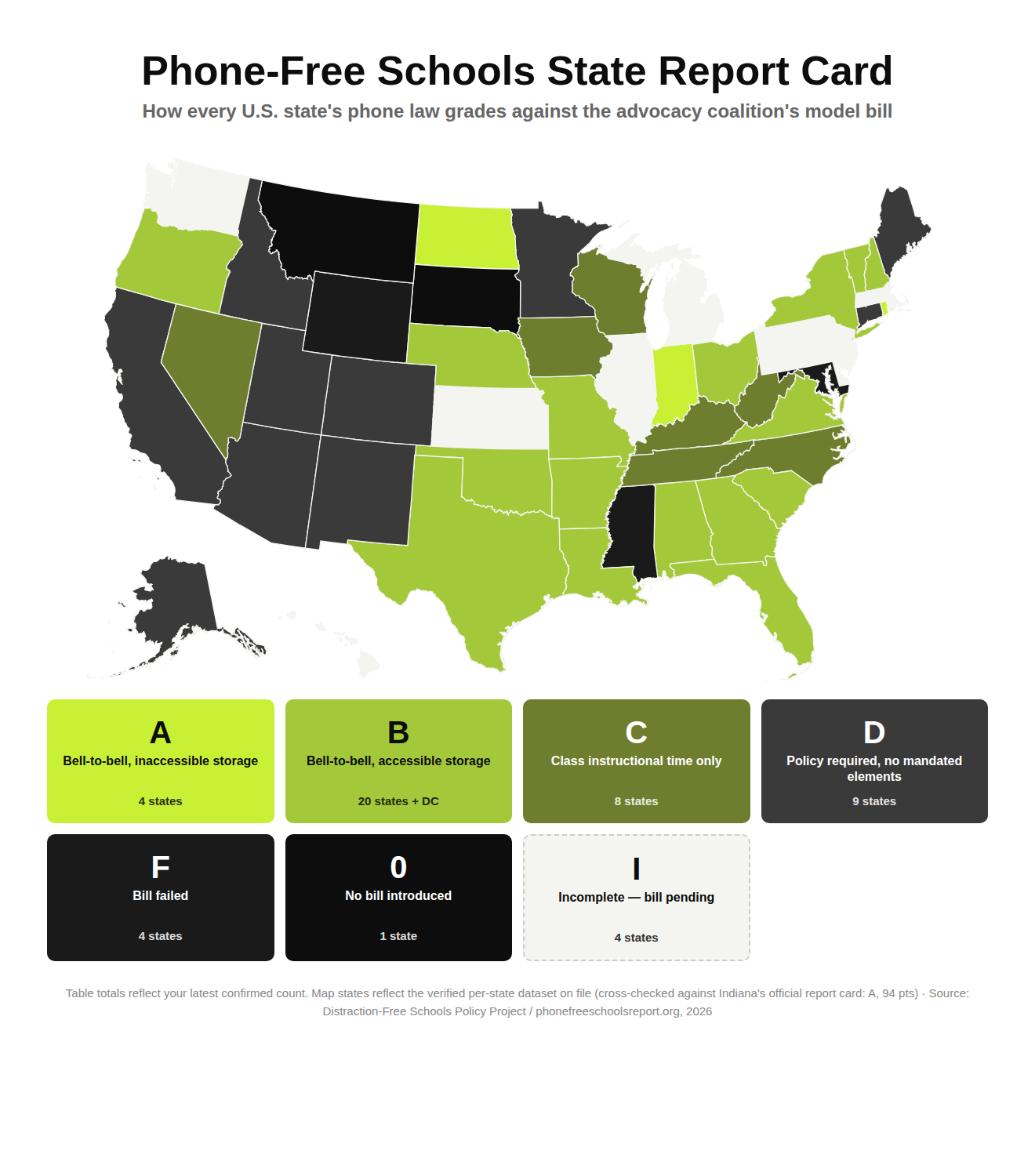
A new Phone-Free Schools State Report Card grades every U.S. state's phone law against what its authors call a gold standard model bill. It is produced by a coalition that includes The Anxious Generation, Smartphone Free Childhood US, the Institute for Families and Technology, and the Becca Schmill Foundation, via the Distraction-Free Schools Policy Project. Unlike the NCSL, Ballotpedia and Education Week tallies used elsewhere on this site, these letter grades reflect an advocacy coalition's own criteria, not neutral government data.
How the coalition grades states
The report card scores each state's law against the coalition's model bill standard. The tiers and their point ranges are set out in the report card's methodology:
| Grade | Points | What it means |
|---|---|---|
| A | 90–99 | Bell-to-bell restriction plus secure, inaccessible device storage |
| B | 80–89 | Bell-to-bell restriction but only accessible storage such as a locker or backpack |
| C | 70–79 | Class-instructional-time-only restriction |
| D | 60–69 | A policy is required but with no mandated elements |
| F / Incomplete | — | States that failed, have no bill, or have a pending measure |
These tiers and point ranges are the coalition's own design, not an objective legal standard.
Only four states earn the top grade
Only 4 states — Indiana, Kansas, North Dakota, and Rhode Island — currently earn the report card's top A grade. The rest fall into the lower tiers, most often because their laws stop at bell-to-bell restriction without mandating how phones are stored during the day.
What separates an A from a B
Per the coalition's own rationale, the single largest factor separating an A from a B is whether phones are stored somewhere genuinely inaccessible during the day. A B-grade state may restrict phones bell-to-bell but still lets students keep them in a backpack or locker, where the report card argues the physical urge to access the device remains. An A-grade state, in the coalition's view, requires storage that removes that access during the school day. This reasoning comes from the report card's methodology section, not from PhoneLock.
Why this distinction matters for schools
The gap the report card draws — accessible storage like a backpack or locker versus secure, inaccessible storage — is exactly the gap a locking pouch is built to close. A locked pouch keeps the device on the student while making it genuinely inaccessible until released, which matches the report card's stated top criterion. A school can meet the spirit of the A-grade standard without new locker infrastructure or confiscation logistics.
Next step
If your school is moving toward a bell-to-bell policy, request a PhoneLock sample pack or a quote to trial the lock and unlock process with your students and staff. Further reading: the USA school phone pouches page and our earlier post Americans Are Warming Up to School Phone Bans — Here's the Data.
Frequently asked questions
- What is the Phone-Free Schools State Report Card?
- It is a report card published in 2026 by the Distraction-Free Schools Policy Project, a coalition including The Anxious Generation, Smartphone Free Childhood US, the Institute for Families and Technology, and the Becca Schmill Foundation. It grades each U.S. state's phone law against the coalition's own model bill, so the letter grades reflect advocacy criteria rather than neutral government data.
- Which states get an A grade on the report card?
- Only four states — Indiana, Kansas, North Dakota, and Rhode Island — currently earn the report card's top A grade, awarded for a bell-to-bell restriction plus secure, inaccessible device storage.
- What separates an A grade from a B grade?
- Per the coalition's methodology, the key difference is storage accessibility. A-grade states require phones to be stored somewhere genuinely inaccessible during the day. B-grade states allow bell-to-bell restriction but permit accessible storage like a backpack or locker, where the coalition argues the urge to access the device remains.
- Is the report card an official government ranking?
- No. The grades come from an advocacy coalition's own rubric and model bill, not from a government body. They should be read as a policy-advocacy benchmark, not as neutral legal data.
Need help with phone-free spaces?
Contact PhoneLock for a free consultation, sample pack or quote for your school, venue or event.